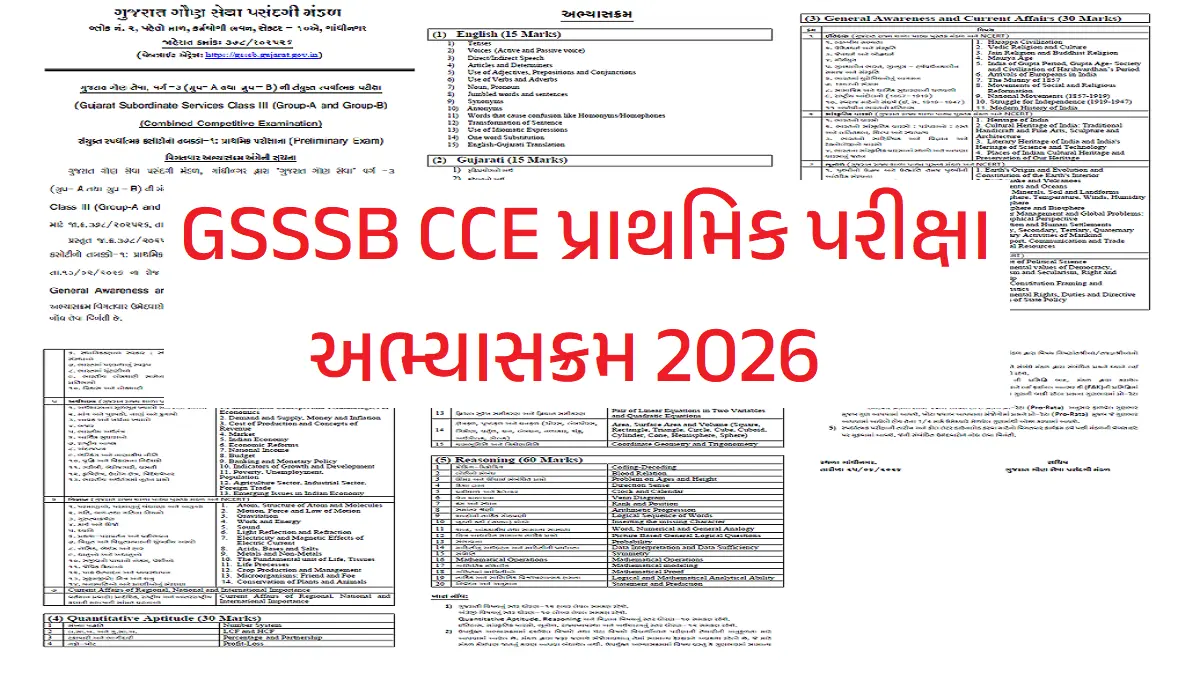
GSSSB CCE Syllabus 2026 has been officially released for the Combined Competitive Exam. Check the latest exam pattern, subject-wise syllabus, marks distribution, reasoning, aptitude, current affairs, and preparation details.
GSSSB CCE Syllabus 2026
The Gujarat Subordinate Services Selection Board (GSSSB) has officially released the revised detailed syllabus for the Gujarat Subordinate Services Class 3 (Group-A and Group-B) Combined Competitive Examination 2026. Candidates preparing for the recruitment examination should carefully review the updated syllabus and exam pattern to strengthen their preparation strategy.
The board has included a comprehensive outline of all subjects, including General Awareness and Current Affairs, to help candidates understand the scope of the Preliminary Examination.
GSSSB Class 3 Exam 2026 Overview
The Combined Competitive Examination is being conducted for various Group-A and Group-B Class 3 posts under the Gujarat Government. The Preliminary Examination will serve as the first stage of the selection process and will assess candidates’ language skills, reasoning ability, quantitative aptitude, and general knowledge.
GSSSB CCE Preliminary Exam Pattern 2026
The Preliminary Examination will consist of a total of 150 marks distributed across five subjects.
| Subject | Marks |
|---|---|
| English | 15 |
| Gujarati | 15 |
| General Awareness & Current Affairs | 30 |
| Quantitative Aptitude | 30 |
| Reasoning | 60 |
| Total | 150 |
English Syllabus (15 Marks)
The English section will cover the following topics:
- Tenses
- Active and Passive Voice
- Direct and Indirect Speech
- Articles and Determiners
- Adjectives, Prepositions, and Conjunctions
- Verbs and Adverbs
- Nouns and Pronouns
- Jumbled Words and Sentences
- Synonyms and Antonyms
- Homonyms and Homophones
- Sentence Transformation
- Idiomatic Expressions
- One Word Substitution
- English-Gujarati Translation
Gujarati Syllabus (15 Marks)
The Gujarati language section includes:
- Rudhiprayog Arth
- Kahevatno Arth
- Samasno Vigrah ane Teni Olakh
- Chhand
- Alankar
- Shabda Samuh mate Ek shabda
- Jodni Sudhikaran
- Lekhan Sudhikaran / Bhasha Shudhdhi
- Sandhi Jodo ke Chhodo
- Samanarthi Shabdo
- Virudhdharthi Shabdo
- Vibhakti
- Dhvani
- Vyanjan-Svar Jodi Shabd Banavo
- Shabdone Shabdkosh Kramma Gothvo
- Vakya Parivartan
- Gujarati-English Translation
General Awareness and Current Affairs (30 Marks)
This section is divided into several important subjects:
History (Gujarat Rajya Shala Pathya Pustak Mandal and NCERT)
- Harappa Civilization
- Vedic Culture and Religion
- Jainism and Buddhism Religion
- Maurya Empire
- India of Gupta Period, Gupta Age- Society and Civilization of Harshvardhan’s Period
- Arrival of Europeans in India
- The Mutiny of 1857
- Movement of Social and Religious Reform
- National Movement (1857–1919)
- Struggle for Independence (1919–1947)
- Modern Indian History
Cultural Heritage (Gujarat Rajya Shala Pathya Pustak Mandal and NCERT)
- Heritage of India
- Cultural Heritage of India: Traditional Handicraft and Fine Arts, Sculpture and Architecture
- Literary Heritage of India and India’s Heritage of Science and Technology
- Places of Indian Cultural Heritage and Preservation of Our Heritage
Geography (Gujarat Rajya Shala Pathya Pustak Mandal and NCERT)
- Earth’s Origin and Evolution and Constitution of the Earth’s Interior
- Earthquakes and Volcanoes
- Continents and Oceans
- Rocks, Minerals, Soil and Landforms
- Atmosphere, Temperature, Winds, Humidity in Atmosphere
- Hydrosphere and Biosphere
- Disaster Management and Global Problems: In Geographical Perspective
- Population and Human Settlements
- Primary, Secondary, Tertiary, Quaternary and Quinary Activities of Mankind
- Transport, Communication and Trade
- Natural Resources
Polity (Gujarat Rajya Shala Pathya Pustak Mandal and NCERT)
- Concept of Political Science
- Fundamental values of Democracy, Nationalism and Secularism, Right and Citizenship
- Indian Constitution Framing and Characteristics
- Fundamental Rights, Duties and Directive Principles of State Policy
- Legislature, Executive and Judiciary in India at Union and State Level
- Government At Local Level: Institutions of Local Self-Government
- Nature of Party System in India
- Elections in India
- Indian Democracy: Challenges and Response
- Development and Democracy
Economics (Gujarat Rajya Shala Pathya Pustak Mandal and NCERT)
- Fundamental Concepts and Terminologies of Economics
- Demand and Supply, Money and Inflation
- Cost of Production and Concepts of Revenue
- Market
- Indian Economy
- Economic Reforms
- National Income
- Budget
- Banking and Monetary Policy
- Indicators of Growth and Development
- Poverty, Unemployment, Population
- Agriculture Sector, Industrial Sector, Foreign Trade
- Emerging Issues in Indian Economy
Science (Gujarat Rajya Shala Pathya Pustak Mandal and NCERT)
- Atom, Structure of Atom and Molecules
- Motion, Force and Law of Motion
- Gravitation
- Work and Energy
- Sound
- Light Reflection and Refraction
- Electricity and Magnetic Effects of Electric Current
- Acids, Bases and Salts
- Metals and Non-Metals
- The Fundamental unit of Life, Tissues
- Life Processes
- Crop Production and Management
- Microorganisms: Friend and Foe
- Conservation of Plants and Animals
Current Affairs
Candidates should stay updated with important Regional, National, and International current events.
Quantitative Aptitude Syllabus (30 Marks)
Topics include:
- Number System
- LCM and HCF
- Percentage and Partnership
- Profit and Loss
- Simple and Compound Interest
- Ration and Proportion
- Time and Work, Wages and Chain Rule
- Time, Speed and Distance
- Mean, Median and Mode
- Brackets and Expansions
- Square and Square Roots, Cube and Cube Roots, Exponents
- Polynomials and Factorisation
- Pair of Linear Equations in Two Variables and Quadratic Equations
- Area, Surface Area and Volume (Square, Rectangle, Triangle, Circle, Cube, Cuboid, Cylinder, Cone, Hemisphere, Sphere)
- Coordinate Geometry and Trigonometry
Reasoning Syllabus (60 Marks)
The Reasoning section carries the highest weightage in the examination.
Key topics include:
- Coding-Decoding
- Blood Relations
- Problem on Ages and Height
- Direction Sense
- Clock and Calendar
- Venn Diagram
- Ranking and Position
- Arithmetic Progression
- Logical Sequence of Words
- Inserting the missing Character
- Word, Numerical and General Analogy
- Picture Based General Logical Questions
- Probability
- Data Interpretation and Data Sufficiency
- Symmetry
- Mathematical Operations
- Mathematical Modelling
- Mathematical Proof
- Logical and Analytical Ability
- Statement and Prediction
Important Notes – GSSSB CCE Syllabus 2026
- Gujarati language questions will be of Class 12 Higher Level standard.
- English language questions will be of Class 10 Lower Level standard.
- Quantitative Aptitude, Reasoning, and Science will be of Class 10 standard.
- History, Geography, Economics, Polity, and Cultural Heritage subjects will be of Class 12 standard.
Conclusion – GSSSB CCE Syllabus 2026
The GSSSB Class 3 Combined Competitive Exam 2026 syllabus (GSSSB CCE Syllabus 2026) provides a clear roadmap for candidates preparing for the Preliminary Examination. Aspirants should focus on high-weightage sections such as Reasoning, General Awareness, and Quantitative Aptitude while maintaining consistent preparation in language subjects. A well-planned study strategy based on the official syllabus can significantly improve the chances of success in the examination.